The problem
The course
Seven tasks, two levels, two minutes — and a course that would tell the robot what to do but never where it was.
A community garden’s caretaker leaves for the season. His plants still need tending, so the College of Engineering is asked for a robot that can do the rounds without him. Every team built one, and every robot was judged on a scale model of his garden.
The model is not a simplification. It has a compost drum that resists being turned, a bucket of apples heavy enough to unbalance a small robot, a window that sticks, and a wall around the whole thing.
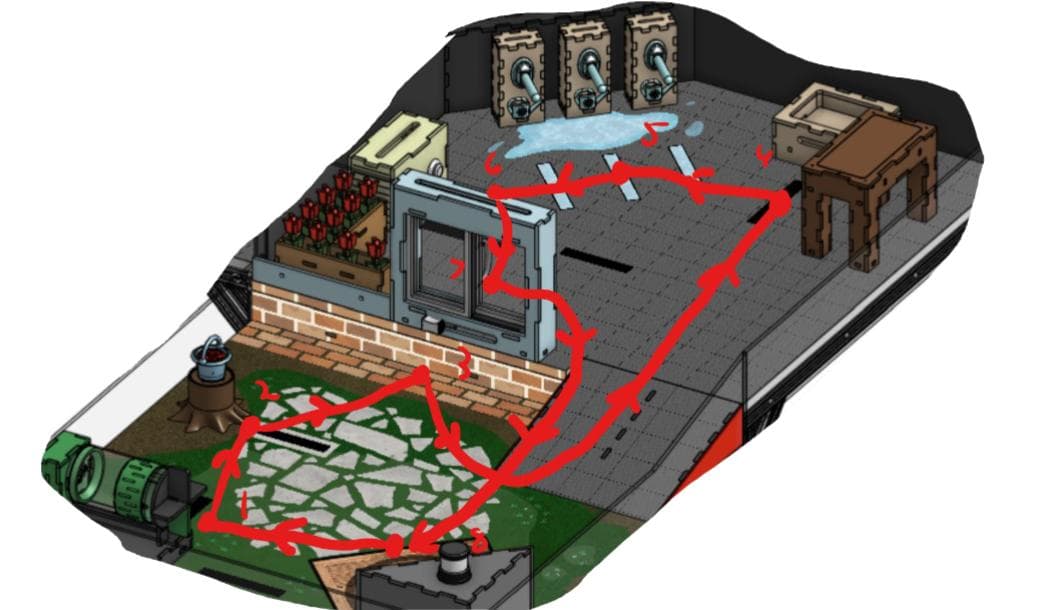
Two levels, one ramp
The garden sits on the lower level and the greenhouse above it, joined by a ramp. Tasks are split across both, so the route crosses the ramp carrying the apple bucket — the robot has to climb an incline while holding a payload high enough to change where its weight sits.
The team measured the climb themselves: 14.04° of incline, needing 1.53 lb of driving force at an estimated 4.23 lb of robot. That calculation is what chose the motors.
What the course asked for
Start on the light
React to a red light in the floor, then press the start button.
Rotate the compost drum
A full turn against a real load — and back to where it started, for bonus.
Carry the apple bucket
Lift it off a tree stump, climb the ramp with it, and set it down on the high table.
Press the humidifier button
Read whether a floor light is red or blue, then press the button that matches.
Flip the fertilizer lever
Ask the course which of three levers, flip that one down, hold, then lift it back.
Open and close the window
Slide the greenhouse window fully open, then shut it again.
Press the final button
Return to where it started and stop the clock.
Most tasks carried a harder version worth more: returning the compost drum to where it started, choosing the correct lever rather than any lever, placing the bucket on the high table rather than in the crate.
What it had to fit inside
- Footprint
- 9" × 9"at the start of the run
- Height
- 12"
- Time
- 2:00for everything
- Controller
- Proteusno modifications allowed
- Budget
- $160finished with $36.99 left
- Control
- Autonomousno contact once it started
What the course would tell it
The robot was not alone out there. A radio link — the Robot Control System — connected it to the course, and the course answered questions.
It would say
- Which of the three fertilizer levers to flip
- Whether a lever had actually been flipped
- When the run was over
It would not say
- Where the robot was
- Which way it was facing
Later years of this course would hand the robot its own coordinates. This one did not. The robot could ask what to do and confirm that it had done it, but never once learn where it stood — and it had two minutes to touch seven specific things scattered across two floors.